
“America’s New “Quantum Dollar”
“Why the biggest monetary shift since 1974 just became a federal mandate
“And the one $20 American company at the center of it.”
That’s the headline of the lastest ad from Dylan Jovine, pitching his Breakthrough Wealth newsletter ($1,997/yr or $2,997 “lifetime” membership, 30-day refund period).
As an aside, I always try to encourage folks to think a bit about what those “satisfaction guaranteed” deals actually mean — I appreciate that Jovine’s group offers a 30-day refund period, since so many of these higher-cost letters won’t offer refunds at all, and some folks always instantly regret getting talked into a subscription that they know is really way outside their budget… but these are also risky investments being made, and you’re not going to know if this particular “quantum’ story worked out in 30 days, so the refund is really just there for the “oops, I shouldn’t have spent that much money!” buyers.
In case you’re curious, we’ve looked at two picks from Breakthrough Wealth in the past — both were during the wild 2021 market run, and both have done horribly since (that was Clovis Oncology (CLVS), which went bankrupt a bit later, and Nerdy (NRDY), a SPAC IPOP that never really captured investors’ attention). As with many publishers, the lower-cost letters from Jovine (Behind the Markets is his basic newsletter) seem much more likely than the “premium” ones to share teaser picks that show up as winners in our Teaser Search system.
But getting back on track, here’s the sum-up from the order form:
“Something irreversible is happening to the money in your bank account.
“It wasn’t voted on. It wasn’t debated in the Senate. It wasn’t announced on the evening news.
“But out of public view, the most powerful people in our government have reached a frightening conclusion: the foundation under the U.S. dollar is no longer safe. And they have begun, in secret, to replace it.
“On June 22nd, the President signed two executive orders in the Oval Office — launching a national program to build a quantum computer more powerful than anything that exists today, and ordering the entire federal government to tear out its old encryption before the wall falls.
“At the center of this once-in-a-generation monetary shift sits a single $20 company — a quantum chip maker so critical to national security that Washington has moved to take a direct ownership stake in it.”
The general spiel is really just about how quantum computers will upend our current cybersecurity and encryption systems, including for things as basic as banking and money transfer, and therefore the government and the banks are going all-out in a race to build quantum-resistant encryption. Which I guess is kind of like “replacing the dollar,” since money really just exists as one and zeros in digital systems, anyway.
And, of course, this is an ad… so there’s “one tiny company” at the heart of solving this problem, and that’s the bait for your $2,000 buy-in to Jovine’s newsletter. Here’s how he hints at that:
“The One Company at the Heart of It
“Building these machines is something almost no one on Earth can do.
“The entire new system of money rests, physically, on a tiny handful of companies that can actually forge quantum hardware at scale.
“Most of that capability is locked inside giants like IBM and Google — where a quantum breakthrough is a rounding error on a trillion-dollar balance sheet.
“You can’t own a meaningful piece of it.”
“Quantum computing is not a side project for this company — it is the whole company.
“When the machine wins, this company wins, with nothing diluting it.”

So what does this company do, you ask? Here’s how they put it in the ad:
“It builds its quantum processors using superconducting circuits — the same fundamental approach the largest players in the world are racing down.
“It has just put one of its most powerful systems yet, with more than a hundred qubits, onto the major cloud platforms.
“And it has published its plan to reach the scale that changes everything.
“You have almost certainly never heard its name.”
We do love to hear that “you’ve never heard of it” bit, though it’s of course almost never true, and Stock Gumshoe readers are rarely all that surprised with a new name. So what makes this one stand out?
Much of the argument is, “the feds bought in”:
“The One Insider That Matters Just Bought In
“In May 2026, the federal government did something it almost never does.
“Washington signed a letter of intent to direct up to $100 million in federal funding to a single American quantum-chip maker.
“And as part of the deal, Washington takes an ownership stake in the company itself.
“Not an ordinary research grant.
“An ownership position in the company’s future.”
Well, the Feds might “almost never” do that kind of thing… but yes, they did sign letters of intent to direct $100 million each in federal funding to nine different quantum computing-related firms back in May. That included investments in two quantum foundry projects, from GlobalFoundries (GFS) and IBM (IBM), as well as seven quantum computing companies, three private (Atom Computing, Diraq and Psiquantum) and four publicly-traded: D-Wave (QBTS), Infleqtion (INFQ), Quantinuum (QNT) and Rigetti (RGTI).
And, to be fair, the government has put a lot of backing behind most (maybe all) of the other US quantum computing companies, too, including IonQ (IONQ) and Quantum Computing (QUBT), other popular names during the first wave of quantum-mania back in 2021… they just weren’t part of this particular CHIPS and Science Act funding deal this year, and didn’t receive a government investment in their actual equity. This time.
More on that “Uncle Sam buys in” point:
“The government has a long history of backing the companies it deems strategically vital.
“Long before the rest of the world catches on.
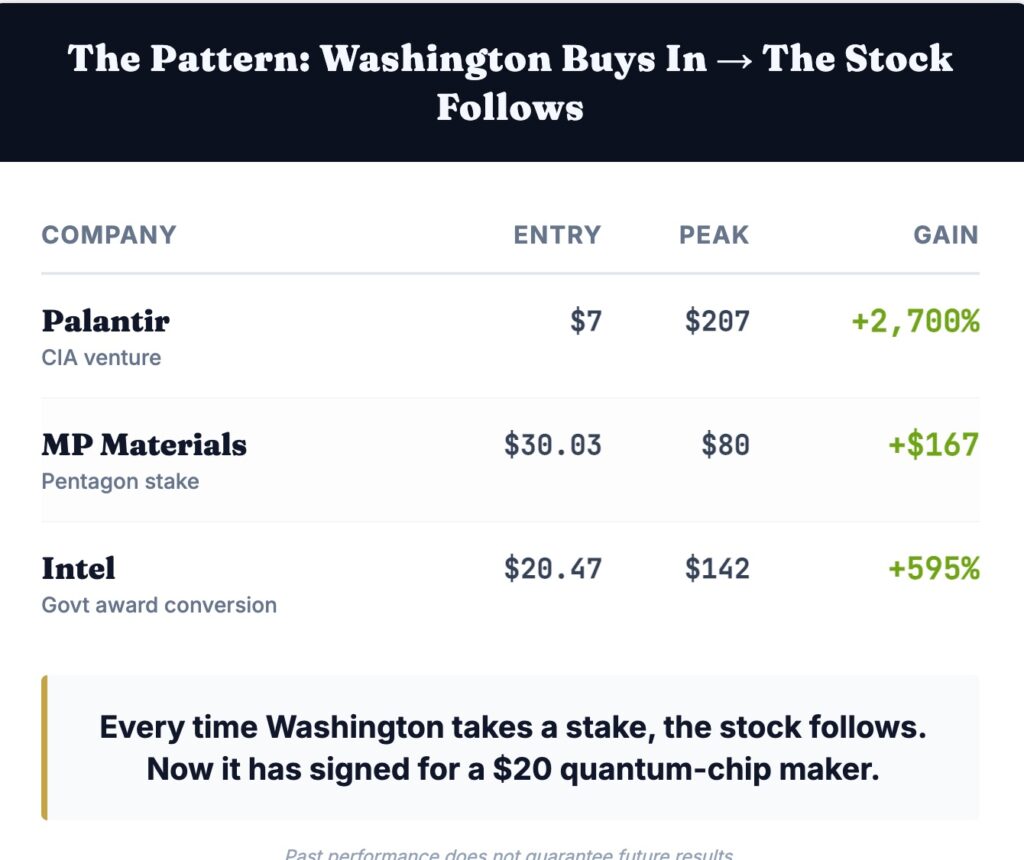
“One of the first companies the CIA’s own venture arm ever backed was Palantir.
“The same Palantir I recommended to my readers at $7.38.
“It has since roared more than 2,700% in under four years — growing more valuable than defense giants like Lockheed Martin and Northrop Grumman.”
That’s true, and I kicked myself for not buying Palantir (PLTR) when it was getting to be reasonably valued, during the 2022-2023 doldrums… but since Jovine often brings this up as a stock he picked at $7 and which could have given investors 2-3,000% returns, I feel compelled to also note that he didn’t advise investors to wait for those 2,000% returns, he posted a sell recommendation in the Fall of 2024 when PLTR was in the $40s and up “only” a few hundred percent.
He did so for good reason, because he felt PLTR shares had wildly outperformed the company’s operating growth, but you can’t have your cake and eat it, too — you don’t earn (or get to claim credit for) 2,700% returns if you sell after ~300% gains.
I’m sitting on my own “picks” that showed extraordinary returns if you squint with one eye, too, to be fair, so if you look in my Real Money Portfolio you’ll see that I started buying Alphabet at a split-adjusted $4.85, about six months after Google’s IPO, so the stock has gone up about 6,500% since I started buying… but I bought more along the way at much higher prices, and have also taken profits and sold some shares over the years, so my total return on investment in that company over the past 20 years or so is more like 700%. The good thing is that the total gain was made on a much larger amount of money than I invested with that first buy, when my portfolio was far, far smaller… the bad thing is that it sounds less dramatic. And my experience with NVIDIA is similar, just to highlight a couple of my better performers, though the gains were compressed into nine years instead of spread out over 21.
So to be fair to Jovine, who made a rational recommendation to his readers to sell Palantir, we will acknowledge that managing a real stock position, with your own actual cash at risk of loss, is a lot different than writing about a stock at one price on one day, and taking a victory lap when it goes up dramatically a few years later. In part because nobody can make you focus on the other couple dozen stocks you wrote about over those years which didn’t go up.
Going off on another tangent, I kind of like the David Gardner/Motley Fool Rule Breakers strategy, at least in theory — you buy a bunch of high-potential growth companies, and you mostly sit on them, buying more shares of only the ones that continue to go up and get more expensive. And you accept that losing on some of them, maybe even most of them, is part of winning — one or two 10,000% gains makes a life-changing difference to a portfolio, and can easily make up for the fact that more than half of your stocks lost money… but that strategy only works if you do end up with a few massive winners, and if you mostly let them ride. You can’t use a ‘stop loss’ to protect yourself, because every great company that gets to 1,000%+ gains will fall at least 30-50% in value during the occasional bad year… and you can’t ‘take profits’ when your stock goes up by 100-200%, even though that feels really good, because the stock you sell at a 200% gain never becomes a 20,000% gain. It’s an appealing strategy… but it’s really hard to stick with during good or bad markets — it’s hard to hold when you know in your heart of hearts that a stock has soared well above the price you think is reasonable, like Palantir did in going from $8 to $40 in 2024, and it’s also hard to hold with conviction when you see your stock falling (Palantir fell from the $40s in 2021 to $6 before it recovered, for example, and so many people felt that fall and reveled in the recovery, which made them sell with a feeling of relief in the $40s or $50s, saying “I’m not gonna go through that again!”, but then PLTR shares hit $200 last year… and perhaps the cycle begins anew, with the stock this year falling back to the $120s.)
Where were we? Right, our little quantum company… some more “gummint buying in is good” commentary from Jovine first:
“When Washington backs a small company, it doesn’t sit and watch. It buys a piece in order to build it.
“Palantir didn’t just get an early check from the CIA’s venture arm. It got the government as its biggest customer — the classified contracts that turned a tiny data shop into the giant it is today.
“Washington ran the same play last summer, on a small American rare-earth miner called MP Materials.
“The Pentagon took a stake — and became the company’s single largest shareholder.
“Then it guaranteed a floor price for the company’s output. For ten years.
“Then it committed to buy what the company’s new factory would produce.
“The stock jumped more than 50% in a single day.”
Well sure, yes, that’s true — but this past year has been extra wacky. The government getting involved doesn’t always mean a straight line to profits, let alone immediate returns (you can believe that the government is full of bureaucratic and self-serving idiots, or you can believe that the government is a great investor and company builder that can choose winners wisely — probably neither is entirely true, but it strains logic a bit too much to believe both at once).
In-Q-Tel, the CIA’s venture capital arm, invested in Palantir in 2004, a decade or so before it became the highest-profile private company in the US for a few years (after Facebook and Twitter went public, and before SpaceX had its exponential growth), and 16 years before PLTR finally went public. And as I loosely referenced above, that IPO was a big hit in late 2020 and early 2021… but then, despite lots of government contracts, PLTR stock lost more than 75% of its value over the next couple years.
Things have changed a lot in this latest evolution of state capitalism, with the government, and sometimes even more specifically just the President, going in to choose “winner” companies, invest in them, and otherwise put their thumb on the scale with big orders or preferential treatment or cheap financing… but the market has also reacted differently, bidding up the shares of government-blessed companies in dramatic fashion instead of, as they sometimes have in eras past, fearing the government’s impulse to bang on the door of the C-suite.
Here’s the graphic from Jovine’s pitch, just to show the recent deals he’s highlighting:
He concludes:
“Washington takes ownership in a small company only when it intends to stand that company up — with contracts, with guaranteed customers, with the full weight of the state behind it.
“And now it has signed the letter of intent for its next ownership position — in a $20 quantum-chip maker.
“A company that will soon be equivalent to America’s new ‘printing press.’
“Washington moves to become part-owner of an obscure quantum firm — and the very next month, the President signs an order launching a national program to build exactly the kind of machine that company makes.
“That is not a coincidence.
“That is the government telling you, as plainly as it ever will, where it believes the future of the dollar is being built.”
OK, so just remember that part up above — the government hasn’t selected one quantum company, it has made similar-size investments in or given grants to dozens of them over the past couple years. Maybe one stands above the rest, that’s a judgement call, but the “letter of intent” stuff and the equity investments announced back in May were spread across nine different companies, half of which you can buy into today if you wish.
Final clues? There’s a little bit here, though it’s more hyperbole than hints…
“This is a company with a tiny revenue base today.
“Which is exactly why the crowd dismisses it….
“When you buy this company, you are not betting on which chatbot wins.
“And you are not buying the Quantum Dollar itself.
“No one can buy a currency.
“What you can own is the company building the machine that new money will run on.
“A pure, ground-floor stake in the physical foundation of the next American dollar.
“Owned, in part, by the very government racing to build it.
“You own the machine the whole new system of money is being built around.
“And I believe it is the single most important position I have put in front of my readers in years.”
And to be fair he does note that this will not be a ‘safe’ investment, and that it could easily swing 20% in a day (I expect all of the quantum “pure plays” have had moves of at least that magnitude, both up and down)… and he offers one last bit of warning/hyper on the order form:
“⚠ WARNING: The $20 quantum chip maker is already seeing massive institutional volume. Washington has signed its letter of intent. The executive orders are in motion. We cannot guarantee this entry price will last beyond today.”
So who’s Jovine’s “Quantum Dollar” stock? Well, if we narrow it down to just the publicly traded companies who were part of the government’s most recent May 2026 “letter of intent” wave of $100 million potential deals, that would mean it’s either D-Wave Quantum (QBTS) or Rigetti Computing (RGTI).
But if we then need to have a company that matches this other clue that Jovine dropped in, “it has just put one of its most powerful systems yet, with more than a hundred qubits, onto the major cloud platforms” … then that means we’re very likely looking at Rigetti, which indeed announced the availability of its Cepheus 108-bit system on Amazon’s AWS Braket platform in April, the first 100-bit quantum gate system on Amazon.
D-Wave also has cloud availability for its quantum annealing systems, which sound larger (thousands of qubits), but that’s a different beast — quantum gate systems essentially mimic the idea of traditional computers, allowing for flexible logic processes, annealing systems are more specialized processors for finding optimal solutions and pathways. D-Wave is also getting into gate processors, particularly through their acquisition of Quantum Circuits a couple months ago, but Rigetti has always been focused on that.
So we’re pretty sure that Rigetti is that primary “Quantum Dollar” stock. And don’t bother looking at the financials, RGTI trades at more than 100X what analysts think they’ll report as revenue next year. There’s no rational way to value that, you just have to believe that their technology will be transformative over the next few years (or that other investors will believe it to be so).
Who will really win in quantum? I have no idea. Jovine also gives a “freebie” recommendation, for those who are less inclined to go for those 1,000% bets:
“I’m going to hand you a way to act on it — for free, right now.
“There is an index fund that owns a basket of roughly seventy companies across the quantum build-out.
“The ticker symbol is QTUM.
“It is up roughly 75% over the past twelve months”
And that is indeed probably the most diversified of the various quantum computing-related ETFs, and the largest — there are others, too, including some like Wisdomtree Quantum Computing (WQTM) that are more levered to the “pure play” stocks in the space, but they’re also much smaller and probably less liquid.
Personally, I have mostly been content to just own Alphabet as a low-risk way to have some quantum exposure, partly because I don’t really understand quantum computing… but mostly because the public “pure play” quantum stocks are all still essentially “pre-commercial” and will require lots of time and maybe even more capital in the decade to come, before we have any real concept of which different hardware and software technologies end up being genuinely useful.
My feeling has been that quantum is a big deal, but it’s also extremely speculative to bet on who the leaders might be — partly because there are a handful of similar-sized players who all seem to believe they’re winning right now, partly because some giant companies are also major players but don’t really show their hand as clearly, like Alphabet and IBM… and partly because, as with so many emerging technologies over the past few decades, it might well be that the real commercial breakthroughs are still in university labs… or, metaphorically at least, in someone’s garage.
That’s more of a personal caution than it is a quantum-specific warning, to be clear — I’m rarely the first guy to get excited about a new technology, partly because they all sound cool, starting in this case with IonQ (IONQ) as the first really prominent “pure play” quantum stock during the SPAC mania of 2021… but they’re also really “not ready to be public,” in my view, these are still much more like venture capital/government research/R&D companies.
I know, I know, the belief that companies should have a proven business model and be profitable before going public is old-fashioned. Maybe I’m just a little grumpy today.
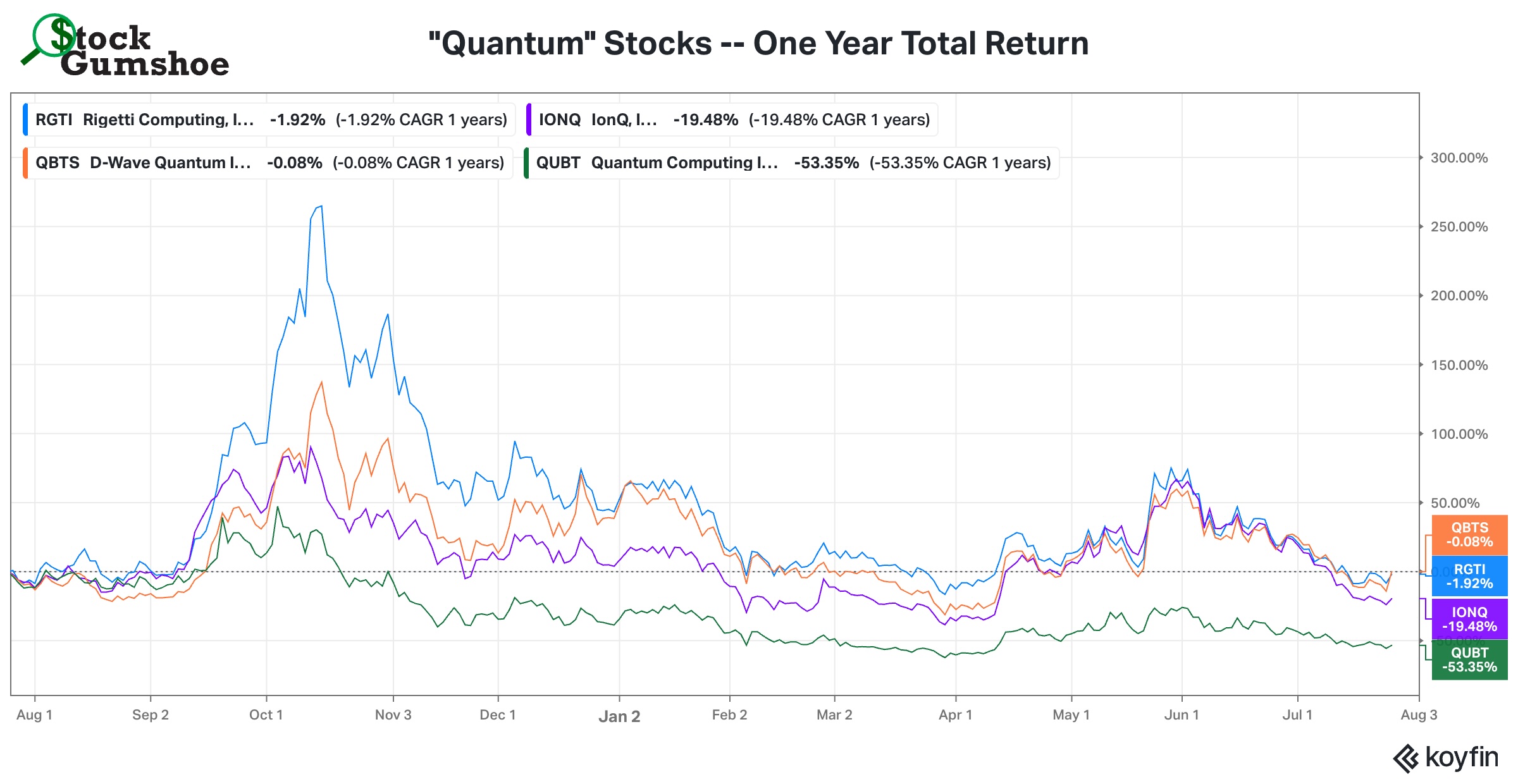
In case you’re curious, Rigetti (RGTI) is indeed a familiar name in these parts — it’s not the most-teased quantum stock, that would still be IonQ (IONQ), but Louis Navellier has talked it up a few times, and Gabe Marshank tried selling the most expensive newsletter we’ve seen in a few years with a Rigetti pitch back in October (that pick is down 70% or so)… but really, the chart of all of the “more mature” quantum stocks, (by which I mean, the ones that have been publicly traded for at least a year, not that they’re “grown ups” in the financial sense), tells us that they’re all being traded as a theme, for the most part, because nobody really knows who’s going to “win” — maybe Jovine does know, or maybe you do, but I don’t:
And Jovine throws in some other “Bonus Report” stocks as part of this pitch, too, shall we see if we can name them for you, and maybe learn anything interesting? Here’s the first…
“Bonus Report #2 — ‘The Titan.’
“Building the machine isn’t only a job for tiny start-ups.
“One of the most powerful technology companies on Earth has already done what most of the field is still chasing.
“It built a quantum chip that crossed the single most important threshold on the road to a working machine.
“Then it ran, in under five minutes, a calculation that would take the fastest supercomputer alive longer than the universe has existed.
“It has the deepest war chest in the race and a full-stack, in-house head start.
“I’ll give you the name, the ticker, and why this giant may be the surest way to own the machine itself.”
OK, so that one’s Alphabet (GOOGL, GOOG), with its Willow quantum chip. We’ve written about that before, and yes, it’s a big deal and Alphabet has been maybe the most aggressive investor in quantum R&D in the public markets, just like they were arguably the biggest investor into artificial intelligence in the half-dozen years before ChatGPT changed the game (that may be an exaggeration, IBM can claim similar prescience in both quantum and AI, as perhaps can a few others, but Alphabet has been “going in big” on both, for a long time, in part because their dominant cash-flowing advertising/search business gave them the capacity for their “other bets,” for massive R&D investments into stuff like AI, quantum computing, and self-driving cars that didn’t need to show a short-term return).
That’s one of my largest holdings, and I’ve owned Alphabet for more than 20 years, so I won’t try to talk you out of that — though neither would I tell you that quantum computing is going to be the most important financial driver for Alphabet over the next few years. And I should note that even after falling a bit after an earnings report that some found disappointing last week, the stock is still at a higher price than I’d want to pay today.
Next!
“Bonus Report #3 — ‘The Shield.’
“The June 22nd order didn’t just fund the offense.
“It ordered the entire government to rip out its old encryption and migrate to quantum-resistant security.
“A forced, deadline-driven overhaul of the digital locks on the entire economy.
“And the same overhaul is now spreading to every major bank on Earth.
“I’ve identified the company set to lead that great switchover.
“The one that protects the data flowing across the new system.
“As quantum-proofing stops being optional and becomes federal law, this company profits from the defense of the money itself.”
Is there one company ‘set to lead’ in this transition? If so, I don’t know what it is, and those clues are not particularly speciifc — we could reasonably argue that either IBM (IBM) or Palo Alto Networks (PANW) is taking the lead among larger quantum-savvy firms… or that Quantum Computing (QUBT) is ahead because they sent some test equipment to big banks last year, or Quantinuum (QNT) because of its next-gen encryption technologies and some test projects with folks like JP Morgan (JPM) (Quantinuum, just FYI, is the quantum company that most challenges IonQ in terms of size and scope, they were formed from the mashup of of Honeywell’s spun-out quantum business and Cambridge Quantum).
Given his clues, all of those could be rational guesses, so we’ll leave you to your own conclusions.
And there’s one more:
“Bonus Report #4 — ‘The Gateway.’
“A quantum machine is worthless until the world can actually use it.
“One company is building the cloud platform the coming quantum economy will be bought, sold, and delivered through — to every bank and enterprise on Earth.
“It is also making a radical, parallel bet on a completely different kind of qubit.
“One that, if it works, could leapfrog every rival in the race to a truly dependable machine.
“I’ll give you the name, the ticker, and why owning the gateway to the quantum economy may be the most overlooked play of all.”
Who’s that? Well, several companies claim radically different hardware strategies, and most of the quantum hopefuls have or partner with some sort of cloud platform (in part because convincing anyone to run their own supercooled quantum machine on premises is a much harder task than asking them to try the processing power on the cloud)… but if we’re talking about pretty easy distribution capabilities and a ‘radical, parallel bet on a completely different kind of qubit,’ I suspect that Jovine here is actually pitching Microsoft (MSFT), with its topological qubits… here’s how they describe it:
“Majorana 1, the world’s first quantum chip powered by a new Topological Core architecture that it expects will realize quantum computers capable of solving meaningful, industrial-scale problems in years, not decades.
“It leverages the world’s first topoconductor, a breakthrough type of material which can observe and control Majorana particles to produce more reliable and scalable qubits, which are the building blocks for quantum computers.
“In the same way that the invention of semiconductors made today’s smartphones, computers and electronics possible, topoconductors and the new type of chip they enable offer a path to developing quantum systems that can scale to a million qubits and are capable of tackling the most complex industrial and societal problems….”
You don’t need me to tell you much about Microsoft, I’m sure — they were crowned the “AI King” for a brief while into last Summer, but have since fallen on tougher times, in part because of their big commitment to OpenAI while Anthropic has been stealing the headlines… and they’re joining Alphabet and Amazon in the wild spending spree for AI capacity, but are back to being cheaper than those two hyperscalers again, at a forward PE of about 21. Microsoft still has overwhelming distribution advantages on the corporate PC side, similar to Apple’s heft on the consumer side, so I’m sure they’ll do just fine — though I have no idea whether their topological qubits will be the winning quantum hardware solution in the end.
Jovine sums up:
“Four companies.
“One new system of money.
“Every one of them positioned squarely in the path of the coming flood of capital.”
But it’s your money, so what say you? Ready to jump aboard the quantum train? (Or back aboard, for those who rode the rise and/or fall of the first quantum stock mania five years ago?). Have any insight into the winning companies, or those with the most rational business plans? Let us know with a comment below… thanks for reading!
Disclosure: Of the companies mentioned above, I own shares of Alphabet, Amazon and NVIDIA. I will not buy or sell any covered stock for at least three days after publication, per Stock Gumshoe’s trading rules.