
This article was originally published on December 17, 2024. I have provided some updates in the Quick Take above, but most of what follows has not been updated. The stock teaser is still circulating from both the US and Canadian outposts of the Motley Fool, and the share price today is within a couple percent of where it was when this article was posted ~15 months ago.
Here’s the intro for the Motley Fool teaser pitch that we’re going to solve for you today…
“Something historic just happened here at The Motley Fool
“We’ve identified a stock so exceptional that we’ve now recommended it 9 times… the only stock ever in the Stock Advisor universe to receive that many recommendations.
“Since we first picked it in July 2016, this extraordinary company has delivered an astonishing 3,477% return.”
The fact that your friendly neighborhood Gumshoe is getting a bit long in the tooth gives us a head start on solving teaser pitches –because I probably wrote about this stock when they touted it in 2016, and I might even be able to remember back that far.
So I’ve already got a guess… but let’s see what other clues they drop…
“… why is NOW the time?
“Because not only has this stock returned over 20X since we first recommended it 8 years ago… but it’s also trading at a steep 35% drop from its peak. Our analysts are calling it a ‘true winner at a discount.'”
This is all about drawing you in to subscribe to their flagship Stock Advisor service, of course ($59 first year, renews at ??), which used to be the place where iconoclastic growth stock picker Dave Gardner and his slightly more value-focused brother Tom made their competing monthly stock picks, as founders of the Motley Fool (which started as an AOL chatroom back in the 90s)… though the brothers seem to have stepped back from those bylines, and the newsletters are now put together by teams of other analysts.
What else do they hint about for this latest re-recommendation?
“… this company is a global leader with a very bright future, handling nearly $950 billion in transactions across 175 countries. We’re talking more online sales than eBay, Target, The Home Depot, and Best Buy… combined….
“The potential for profit is immense, with revenues growing at a compounded annual rate of more than 40% over the past 5 years….
“Our quant projections show potential annual returns of 13% to 15% for shareholders. That’s a heck of a lot better than the 4.5% your high-yield savings is giving you.”
Interesting, I think that’s the first time I’ve ever seen the Fool promote its “quant projections.”
More from the ad about a couple of their past re-recommendations:
“Now in the past, when we’ve re-recommended stocks, they tended to be our highest conviction picks… and some of our biggest winners….
“Netflix received a total of 7 recs. And it wasn’t our first rec that saw the highest returns! In fact, it was a re-recommendation that saw sky-high returns of 36,162%.
“Then there’s Amazon, receiving a total of 5 recs in Stock Advisor, with the initial returns surpassing 24,000%. “
Those were both teaser pitches that I covered at the time… but sadly didn’t buy personally. Motley Fool Stock Advisor does have a pretty exceptional long-term record as a model portfolio, but like most growth-focused investors it is very much the Pareto principle driving those returns — a very small number of exceptional picks, like Netflix and Amazon early on, provide a large percentage of the overall returns. They often have more than 100 recommendations in that newsletter, and they almost never sell to reduce losses or take profits, just letting the cream rise to the top. That’s been very successful over the past 30 years, and it’s not unique to the Motley Fool — many exceptional investors have made most of their money by finding a few fantastic companies and just holding on tight, with their eyes squeezed shut. The caveat is that it’s not always easy for individuals to follow as they read an advisory or skim through a model portfolio — particularly if they pick and choose among the stocks and don’t happen to have bought some of the better performers, or don’t “buy in” to that particular investing philosophy.

But anyway…which stock is it today?
“But this is the first time we’ve ever recommended a stock 9X. That’s unheard of. We truly think investors who don’t buy this stock today will regret it in 5 years time.”
It’s hard for me to believe that they haven’t recommended any stock nine times before — I’ve covered so many teaser pitches of theirs for leaders like The Trade Desk (TTD) and Arista Networks (ANET) that it feels like they’ve been recommended more than 9X in just the past few years… but we’ll take them at their word.
This “9X recommendation” must be Shopify (SHOP), which first came to our attention in June of 2016 when the Canadian version of Motley Fool Stock Advisor teased the company, and then a month later was taken up by David Gardner here in the US as the “little-known stock that took on Amazon, and won”.
And it was certainly an excellent pick at the time, with, as teased, more than a 3,500% gain if held to today (not quite atop the teaser tracking spreadsheet for 2016, Enphase and NVIDIA were more dramatic winners that were teased that year… but pretty close).
Shopify was pretty small back then, with a market cap of about $2-3 billion and a split-adjusted share price of about $3, and it’s now a $150 billion company and trades for well over $100 a share, so it has obviously done well, and they’ve teased and promoted it a few times since… but it hasn’t been an easy ride. (And yes, in case you’re checking off those clues, the $950 billion number is a match, too — though it’s slightly out of date now, and is cumulative… Shopify has handled about $1 trillion in sales, globally, since it was launched in 2006… and that number was $236 billion in Gross Merchandise Volume just for 2023, so it’s changing fast.)
Shopify is primarily an e-commerce software platform and payment processing company — they built what retailers eventually decided was the best platform for creating an online store, and that software offering ballooned into dozens of add-ons and services that they sell to retailers, as well as a very vibrant marketplace for software plug-ins that Shopify users can buy from other developers… and they built in a powerful and easy payments platform for those retailers, which allows Shopify to capture a little more of the economic value as they collect their little slice of credit card network merchant fees.
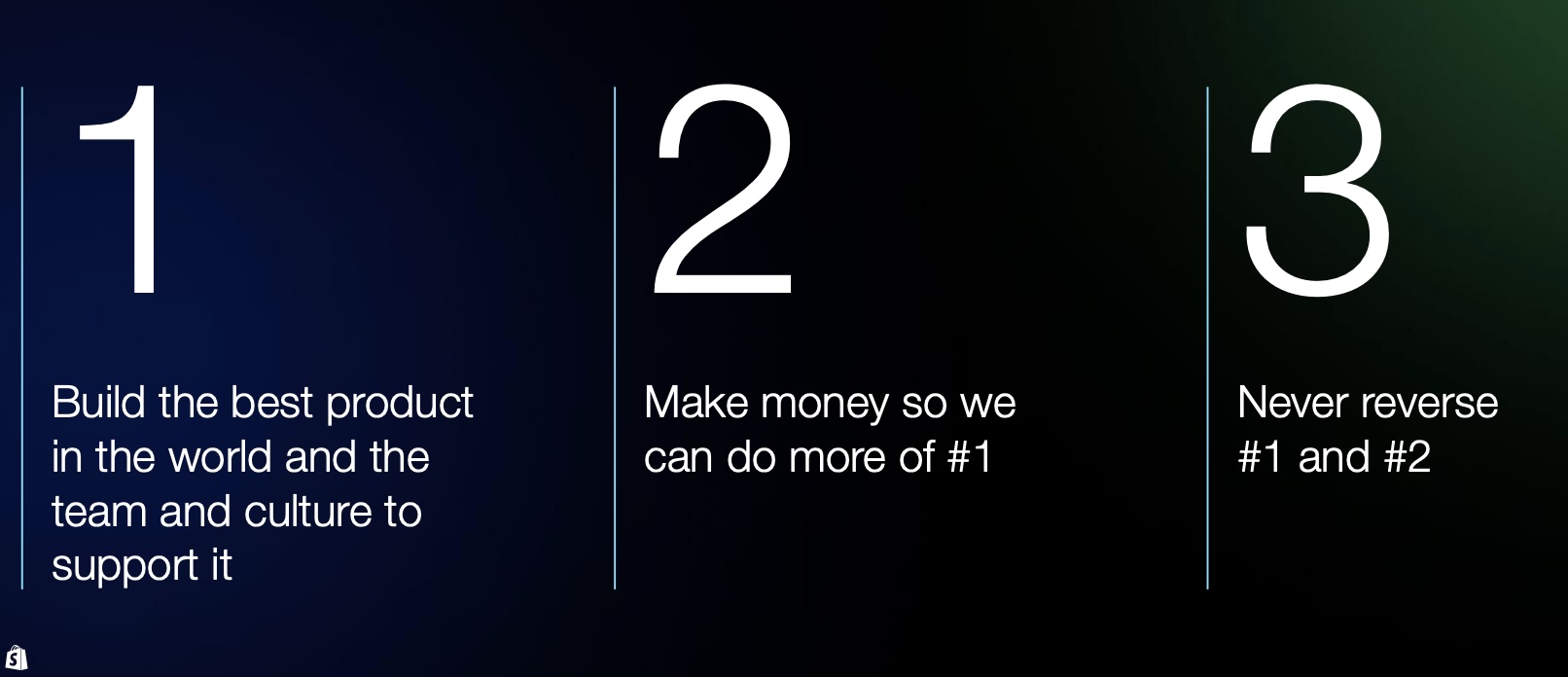
And the appeal for investors has been that they very much adopted the Jeff Bezos strategy for growth — pour all the cash you generate back into making the platform better for retailers, and expanding on the dominance of your platform to take away reasons why anyone would ever consider signing up with the competitors, who can’t spend as much on R&D or offer as great a product, and worry about stuff like profits later. Sometimes a simple image clarifies that, and this is a slide from their Investor Day presentation that reminds me of those early Jeff Bezos shareholder letters:
That strategy was tailor-made for the pandemic, as Shopify was ready to help the millions of stores who were suddenly forced to adopt an e-commerce strategy, and they grew so fast that they almost couldn’t help but become profitable… but they they also got a little bit out ahead of their skis when they launched their plan to compete with Amazon on fulfillment, building up a warehouse network of their own, which had the potential to come at an extreme cost. Building better software than Amazon is certainly possible, but replicating their global fulfillment infrastructure seemed a bit of a fool’s errand — and when the demand started to slow as the pandemic passed, and investors started looking much more closely at valuations in 2022, SHOP fell hard with all the other COVID darlings.
They have started to come back now, as the company resets for its slower growth rate — like their big-tech brothers, Shopify overhired in 2020 and 2021, (the employee count doubled in two years), and had to go through layoffs, and they also pared back their commitment to their big infrastructure build-out project, partnering that division with Flexport, a shipping and fulfillment startup, so they could take it at least partially off of their own books. That has cleaned up the story a bit, and simplified the business, so where do we stand now?
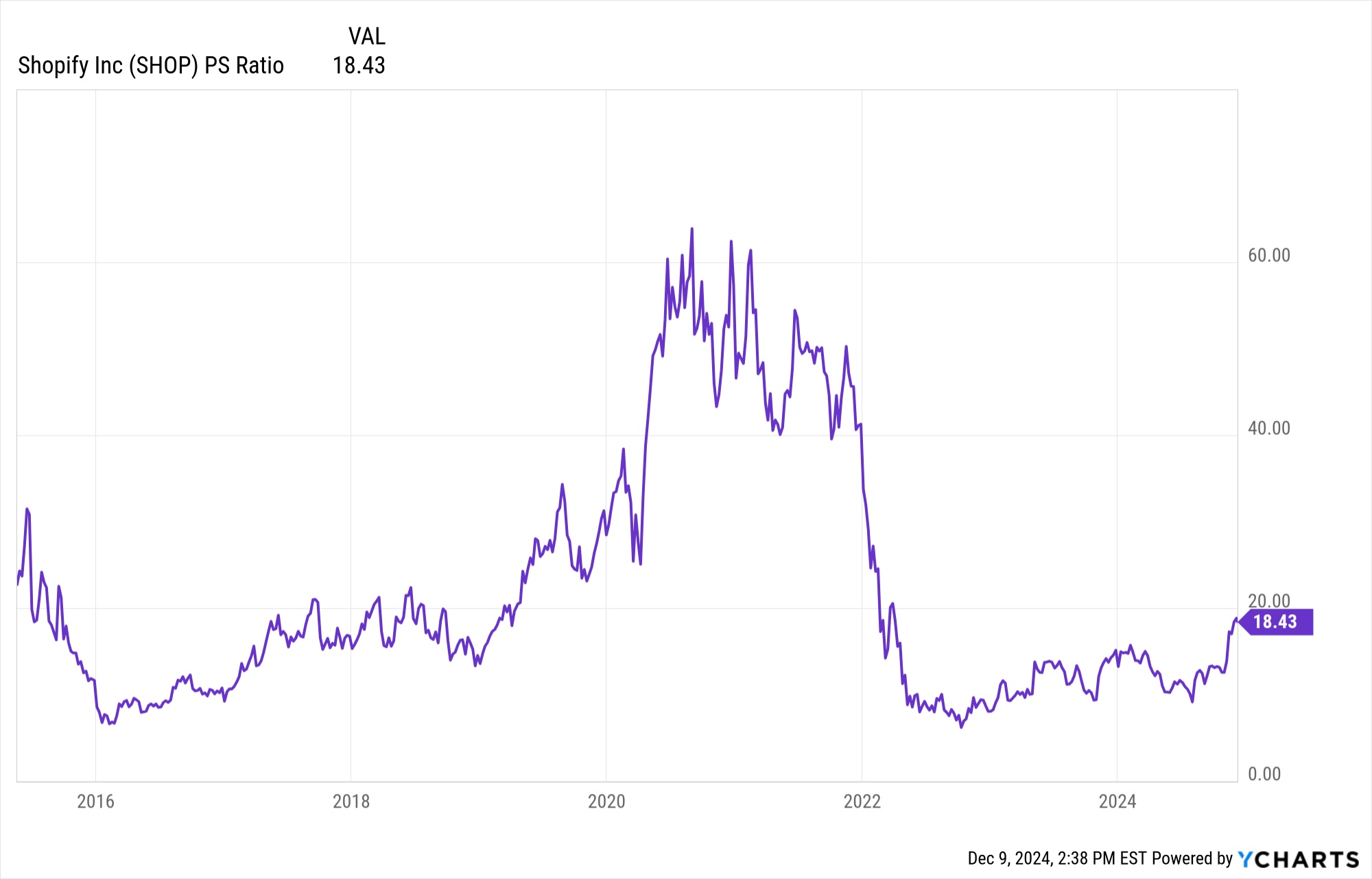
Well, the valuation for a while got back to where it was in the early days… they were down around 10X sales back in 2016, and they drifted back down to about 12X sales over the Summer, the last time I covered a similar pitch. That’s a welcome dose of sobriety after that crazy year or so when they traded at 50-60X sales… but the punchbowl is starting to fill up again, and SHOP is closing in on 20X sales…
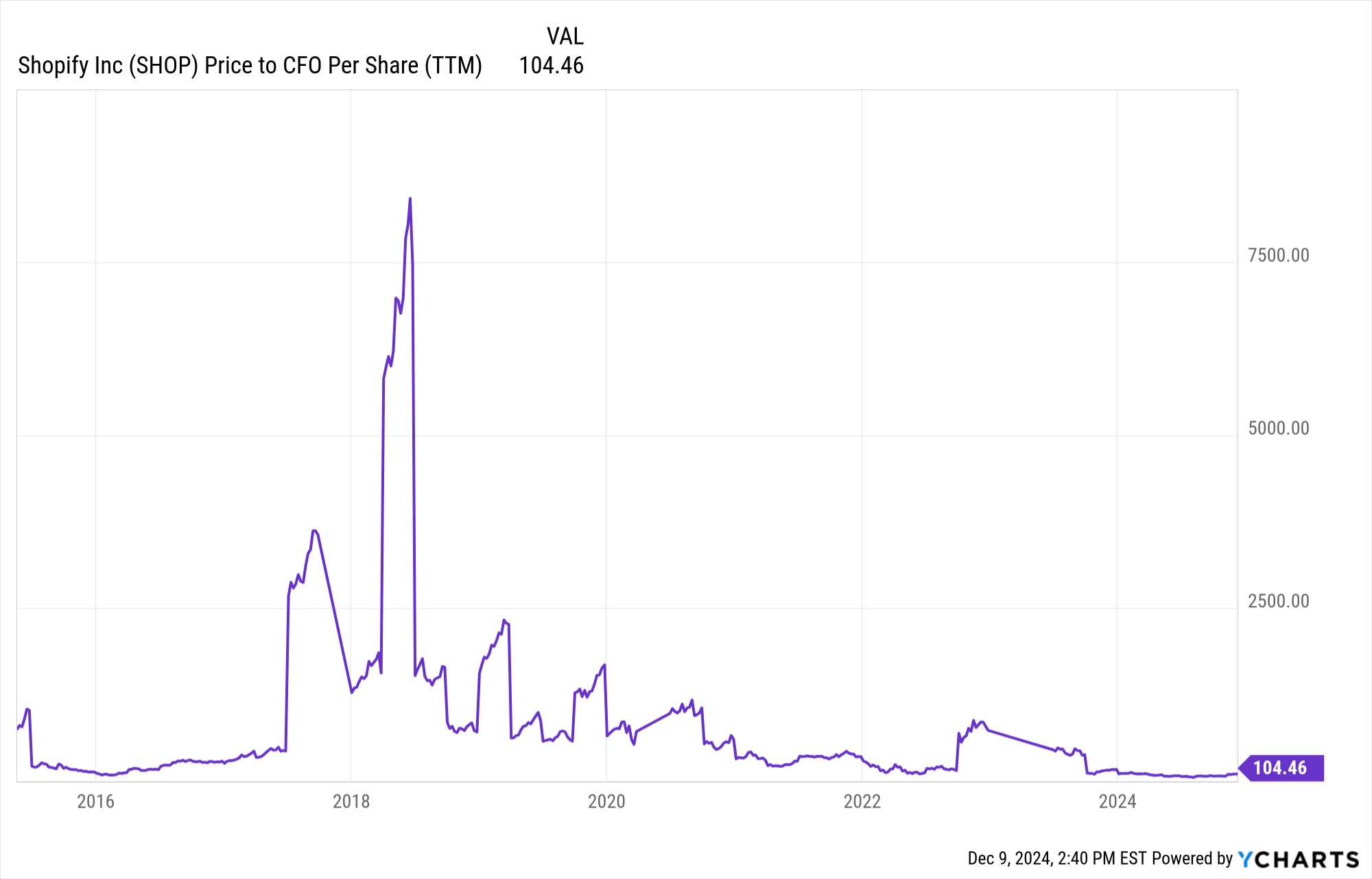
And when it comes to cash flow from operations, which is the metric most folks use to analyze mega-competitor Amazon, Shopify has also drifted back down to a much lower valuation, roughly where they were in their early days at about 800-100X CFO, though by that measure, too, the valuation has been turning up a big in recent months.
But you’ll notice that the numbers I noted above were sales and operating cash flow… not profits. This chart of the past five years helps us remember just how impactful the pandemic was on the e-commerce world, that purple line is revenue per share, which kept growing fantastically and more than quadrupled in those five years… but the orange line is net income, which exploded higher and then, when the business slowed but the expenses were still very high and growth-focused, collapsed dramatically. So we’re more or less back on some kind of even keel now, where we might have expected to be if COVID hadn’t happened.

So where do we stand today? Shopify is the dominant provider of e-commerce software, they touch about 10% of US e-commerce now, far and away the second-place leader behind Amazon (and yes, they make it easy for Shopify merchants to sell on Amazon’s marketplace, or in Walmart’s, or in tons of others), with strong growth in both gross merchandise volume (the dollar value of sales made using SHOP software) and software subscription revenue. And they have gotten back to being just barely profitable (if you ignore their big writeoff for restructuring the fulfillment business). This is still very much a growth-focused company, and they still have a lot of stock-based compensation — but they’ve also grown big enough that it’s not a massive driver of results at the moment, and the share count has only gone up by about 5% since COVID started.
Analysts currently estimate that Shopify will have $1.32 in adjusted earnings per share in 2024, up from 73 cents last year and an expectation of less than a dollar just six months ago (GAAP earnings will be up from ten cents to 90 cents, with the Flexport stuff having more of an impact than stock-based compensation on the “adjustments”). The expectation is that the adjusted earnings number will keep growing at 20%+ per year, but analysts do have trouble with guessing at that growth rate. However it turns out, that’s obviously not comparable to the 100%+ growth during COVID, which got everyone way too excited, but it’s still exceptional earnings growth. And, sadly, that means we have to pay a pretty exceptional price — SHOP today has more than doubled from its lows over the summer and is trading at about $115, so that’s more than 80X estimates for this year’s adjusted earnings (about 75X next year’s estimates).
I still think SHOP is a great company, and I love it as a consumer (I’m much more likely to buy something if I see that easy “Shop Pay” button), and I’ve owned the stock since 2017, taking some profit off the table a couple times during the manic years, but I haven’t bought any more shares recently. That might just be because my thinking is still anchored in the boom and bust of the past few years, so there’s probably room for more optimism if you really buy into their sector dominance — if you want to talk yourself into paying a high price, I recommend starting with CEO Tobi Lütke’s last appearance on Invest Like the Best, on October 22, for some reason, Lütke’s clarity of vision and excitement for the work they’re doing at Shopify always makes me want to run through a wall.
Shopify is having a great year, with a very strong start to the holiday season (their Black Friday/Cyber Monday sales were up about 25% from last year), so the future still looks pretty bright… but those “strong consensus about a bright future” moments aren’t necessarily the best time to buy unless you’re ready to commit to a long holding period and ride some significant volatility (the general rule with richly valued growth stocks, for those of us who aren’t trying to trade in and out very often, is that the more you pay, the more patient you have to be). Here’s an excerpt of what I wrote to the Irregulars about Shopify following their last blowout earnings report:
“I wrote a few weeks ago about how much I admire Shopify (SHOP) and CEO Tobi Lutke, but I’ve often been unable to justify the valuation and buy more… and that got tougher again this week, when a very strong earnings update sent the stock soaring another 25% higher…. I first bought SHOP in 2017 for about $7, so seeing the stock jump $22 in one day is pretty wild (that’s what the Motley Fool folks call a “Spiffy Pop,” when a stock jumps more than your cost basis in one day — though I’ve bought and sold more along the way, so my cost basis is actually negative, and my average purchase price is about $15). The stock price is now back to where it was at the end of 2020, when optimism was extreme and every single retailer in the country was desperate to move into e-commerce… though now, of course, the valuation is closer to being sensible — it’s still trading for less than 20X sales, and back in late 2020 it was around 50X sales.
“So we are in the position we’ve been in many times with high-quality, high-growth companies: Too expensive to buy with a straight face… But too good to sell. It is still entirely possible for an investment at these levels in Shopify or The Trade Desk (TTD) or even NVIDIA (NVDA) to work out… it’s just a lot less likely than it was at times over the past 2-3 years, when valuations were more clearly rational. It’s great to see Shopify getting back on track with their core business, now that the distractions of the fulfillment business have faded, and there’s still plenty of room for growth (the Fools are still pounding the table for TTD these days, in addition to SHOP) — but I still can’t make it work with any kind of cash flow or earnings-based valuation model when we’re well above $100. Shopify remains a hold for me… this is still a $100+ billion company (now $150 billion) that only has $1.5 billion dollars in annual operating cash flow, so we either need a lot more growth or we need to be very patient.”
June 2025 Update:
Here’s an excerpt of what I wrote to the Irregulars following Shopify’s last financial update, on May 9:
Shopify (SHOP) reported a decent quarter, with better-than-expected growth but also higher costs. And, as you probably would have expected, Shopify management also noted that tariffs, especially the US tariffs on Chinese imports which currently amount to more of a trade embargo, pending whatever progress might be announced about any future deal, are going to have a significant impact on their customers… and therefore on Shopify’s future earnings.
Shopify has a great variety of customers around the world, but a lot of those customers are in the US, and a portion of those are selling imported goods… including a bunch who are essentially “drop shippers” who sell things that are made overseas and shipped directly from the manufacturer to the end customer in the US under the “de minimis” rule (items under $800 don’t incur customs fees or tariffs). The de minimis rule is gone now, and tariffs are (for the moment) huge on many suppliers of those products, especially China, so that could lead to a lot of Shopify businesses shutting down, at least temporarily.
So… Shopify remains a great business, but it might have a pretty bad year… we’ll see how it goes. I’ve sold some of my SHOP shares when it was both overvalued and hitting stop loss levels in the past, but really like the company and try to give them the benefit of the doubt, especially during the first quarter, which is seasonally their weakest. It’s also possible this tariff mania will benefit SHOP in the end, since they are far bigger than their competitors and have the ability to invest in improving their marketplace products, including with tools to help sellers deal with tariffs and rapid changes to their fulfillment strategies, but that probably won’t help quickly if a lot of sellers see their business freeze up. I’m not changing my “buy under” levels at this point, nor am I changing my holdings. That seems to be the consensus at this point, so this is not a particularly bold stance I’m taking.
And that’s all I’ve got for you today, dear friends — great company, it was in our buy range for a few minutes over the Summer and is now well above the price I’d be willing to pay… but also has a management team I really like, and the business has great scalability and growth potential as they move ever more into global markets, so I continue to I really like the company, and am likely to hold for a long time.
Which is all just my thinking, of course, and when it comes to your money it’s your thinking that matters — so feel free to share. Eager to buy Shopify here? Think there are better growth opportunities elsewhere? Let us know with a comment below. Thanks for reading!
Disclosure: Of the companies mentioned above I own shares of Shopify, The Trade Desk, NVIDIA, MercadoLibre and Amazon. I will not trade in any covered stock for at least three days after publication, per Stock Gumshoe’s trading rules.
I am a longtime subscriber to Stock Advisor and yes the Fool has recommended SHOP 9 times. Buyer beware though. The 9th time was on 6-6-24 at about $61. The stock is up 88 percent since that recommendation. Great buy at that time but not at current price of $118 as Travis states current valuation is too high.
My dilemma is that a decision not to sell is the same as buying. I’m up 168% having bought on a previous dip after watching it for a while. But oh my is everything lofty these days. My mindset has also gone from “I want to buy things I won’t be selling for a looong time” to “Hum, retirement is getting in the ‘any time now’ frame”. Not sure I want to keep riding out long corrections. Surely one is to come.
For what it’s worth, one of those recommendations is in the red and 2 of them are trailing the S&P 500 (those recs are all from 2021, no surprise). SHOP and TSLA appear to be Tom Gardner’s go-to stocks when he has nothing else to recommend.
right
we ‘ ll never see it again at 61
Maybe. SHOP has seen both $160 and $40 in the last two years, things feel certain and unstoppable when a stock is moving either up or down for a few months in a row, but the market tends to make fools of most of us at those times.
You will when it splits again. I discovered Shopify though Travis and then researched on Motley. I am a conservative investor but this was one I had to take a chance on…I bought it when Travis first wrote about it in Feb 2017. Shopify is today at a 1631% gain in my Roth. IT has been higher, but I believe it is a long term hold .
My concern in the short term is the increasing amount of consumer debt the US owes on cards. I believe there is certainly going to be blowback on the market sooner rather than later. But great article and I will keep an eye on this one.
Thanks for that detailed description Travis. In the past I’ve largely ignored the stock because I keep mistakenly assum that they’re merely a direct e-commerce competitor of Amazon that I’m certain will get crushed but you’ve explained well how they’re primarily a vender of a software platform that enables retailers to create their own e-commerce platform.
I used to subscribe to MF but as you mentioned they almost never recommend a sell. In 2019 I invested in Zoom based on their recommendation. At that time no one anticipated Covid. As we all know, the pandemic launched Zoom into the stratosphere. I made 5x at its peak. However, they never gave a sell recommendation. I got out at 3x.
I bought TDD, ANET, and SHOP based on their recommendations. Very happy, but FFS tell people when to get out.
I also have concerns about the exit of Tom and Dave.
I subscribed to Tipranks (can I mention a service?) and I have beaten the SPY 127% vs 51% over the last 22 months (when I started using their service) , with an average 36% return on my trades.
I used to subscribe to MF but as you mentioned they almost never recommend a sell. In 2019 I invested in Zoom based on their recommendation. At that time no one anticipated Covid. As we all know, the pandemic launched Zoom into the stratosphere. I made 5x at its peak. However, they never gave a sell recommendation. I got out at 3x.
I bought TDD, ANET, and SHOP based on their recommendations. Very happy, but FFS tell people when to get out.
I also have concerns about the exit of Tom and Dave.
I subscribed to Tipranks (can I mention a service?) and I have beaten the SPY 127% vs 51% over the last 22 months (when I started using their service) , with an average 36% return on my trades.
Hello, Have there been any clues as to what the fool is talking about in their “Double Down” recommendations?
The stocks they’ve pitched in the past with that “Double Down” terminology have mostly been The Trade Desk (TTD) and Arista Networks (ANET), both of which have been recommended multiple time, though I haven’t seen a “double down” ad recently.
Even with the massive drop in price, the current Price to Earning ratio is 94.10 ! NO THANKS